Diversion Loads in Solar Thermal Space Heating
With any solar-powered heating system, whether it's for the domestic hot water supply or space heating, a diversion load can be essential to safety and the system's lifespan.
Since evacuated tube collectors are, by necessity, a closed system inside their collector box, many of them use a neat technological idea called a heat pipe. Instead of simply passing the gathered heat out along a piece of metal to the manifold (and thence to the storage tank to heat your water), they use a two-stage approach.
Assuming you're installing a closed-loop, pressurized solar thermal system, a pressure gauge is absolutely essential. You can place it almost anywhere in the loop, but it's best to locate the gauge close to the charging ports.
Since a pressurized system has a solar loop which is completely filled with fluid (the industry standard being a mix of water and propylene glycol), it is very important to get all the air out of the system when you're setting up. This is doubly important because the solar fluid only needs to be checked every 10 or 15 years, so it's going to be in there a long time before you look at it again.
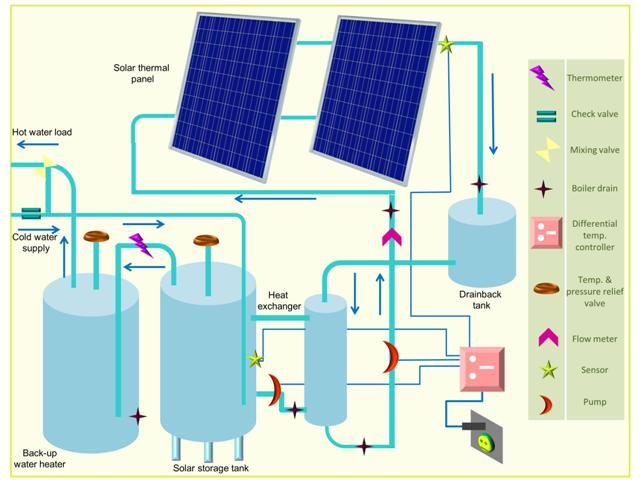
If you think a drainback solar hot water system fits your needs, you must consider a wide variety of rules, limitations and requirements, as outlined below.
The choice of collector array for drainback systems is more complicated than for a pressurized system: some evacuated tube collectors cannot be used at all (check with the manufacturer) and any collectors that use serpentine riser tubes are also ruled out.
The single biggest use of solar thermal systems worldwide is to heat swimming pools. As a result, special technologies have appeared that facilitate this use, the best of which is a web-and-tube setup. The requirements for seasonal pool heating are much simpler than those for a whole-home, all-season solar thermal system: the water only needs to be heated to a little above ambient temperature, the collectors don't need to be climate-proof (as they're only laid out in hot months, when needed) and they don't need any glazing.
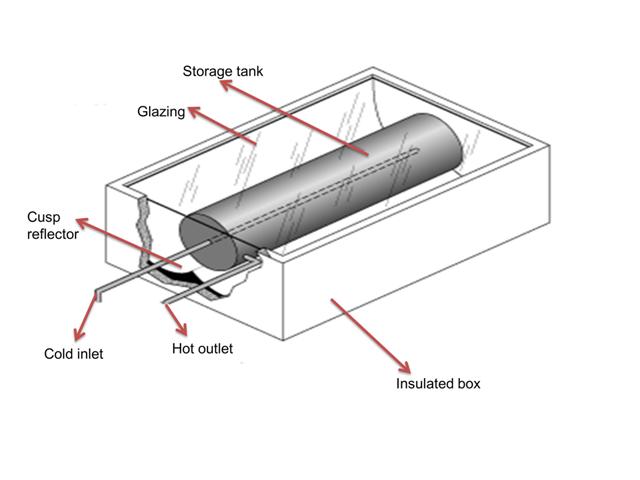
It doesn't matter whether you're installing a huge solar thermal system to heat the water for an entire community or a small residential setup to lower your power bills: you'll need a storage tank to keep hot water in. And since the sun has an annoying tendency to be weaker in winter and disappear at night, that tank needs to be insulated to keep your water hot as long as possible.