How Efficient is a Solar Collector?
As you should already know, choosing the most efficient collector for your solar thermal installation is more about your situation, location and climate than it is about just picking the top-rated one off a list.
As you should already know, choosing the most efficient collector for your solar thermal installation is more about your situation, location and climate than it is about just picking the top-rated one off a list.
As you are probably aware, the SRCC (www.solar-rating.org) rates both efficiency and durability from the results of ASHRAE's (www.ashrae.org) tests. Thankfully, durability is less of an issue when you're comparing solar collectors because the vast majority of manufacturers build their products to last.
When it comes to your local climate, there are some factors that can seriously affect your choice of collector type. The worst non-catastrophic climatic event for solar thermal installations is, without any doubt, snow. It's the worst because, unlike rain or total cloud cover, it can physically pile up on top of the collector and block out the sun's light.
Despite all the advances of modern technology, the best solar fluid for use in a solar thermal installation is water. It retains and transfers heat better than any other liquid in the world. However, it has one major drawback: it freezes easily.
The industry standard for solar fluid is a mix of propylene glycol and water. It's non-toxic, biodegradable and relatively stable. However, you should always mix as much water as possible with your choice of glycol product, as simple water is the ideal solar fluid.
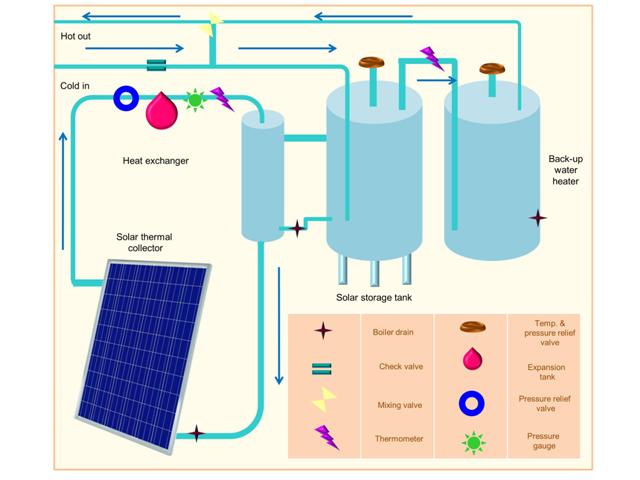
As everyone knows, just about everything expands when it gets hotter. With gases, they can exist in the same space and build up pressure, but liquids have difficulty doing that – when a liquid expands, it needs more space.
When you first set foot in the renewable energy arena, it can look daunting: different technologies, different approaches, net-zero, net-positive, PV arrays, solar thermal, geothermal, wind power... it's a big subject and can be confusing. So where should you start?
There are some things you can do to save energy and money before you install even the simplest renewable energy system. The three simple steps are to reduce losses, increase efficiency and reduce consumption.
Integral collector storage (ICS) solar hot water systems are the cheapest, simplest installations. Consequently, they have more limitations than other, more robust setups but are a lot easier to set up and maintain. They are open, passive systems.
It doesn't matter whether you're looking at renewable energy from the point of view of saving money or saving the environment: solar thermal systems are a great way to take your first steps. As it happens, preserving the environment and reducing your bills often go hand in hand, although it may not be immediately apparent when you look at the cost of installing new systems!