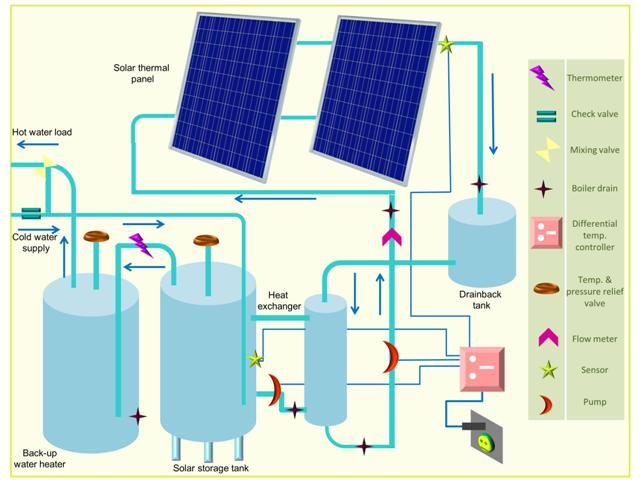
Thermosiphon Solar Thermal System Layout
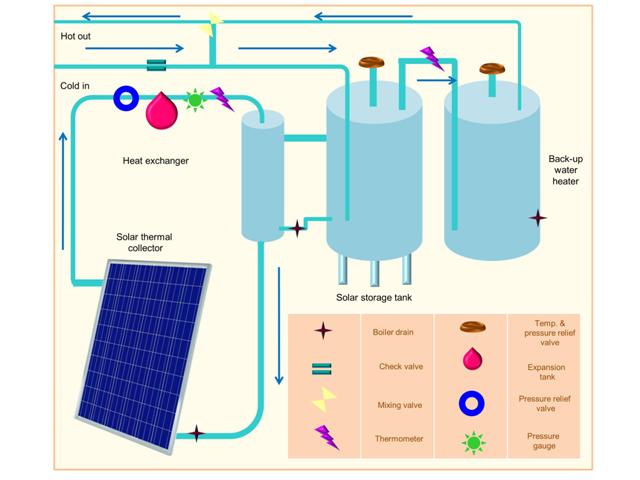
The industry standard for solar fluid is a mix of propylene glycol and water. It's non-toxic, biodegradable and relatively stable. However, you should always mix as much water as possible with your choice of glycol product, as simple water is the ideal solar fluid.
Integral collector storage (ICS) solar hot water systems are the cheapest, simplest installations. Consequently, they have more limitations than other, more robust setups but are a lot easier to set up and maintain. They are open, passive systems.
As solar power becomes more familiar, innovations appear and new ideas are applied to existing technology to either improve output or come up with entirely new ways of harnessing the sun's renewable energy for everyday use. Solar chimneys are one of those innovations that could one day produce power on a grand scale.
These systems have the following advantages:
It's also important to consider the disadvantages:
Since evacuated tube collectors are, by necessity, a closed system inside their collector box, many of them use a neat technological idea called a heat pipe. Instead of simply passing the gathered heat out along a piece of metal to the manifold (and thence to the storage tank to heat your water), they use a two-stage approach.
These systems have two main advantages:
It's also important to consider the disadvantages:
These systems have three main advantages:
It's also important to consider the disadvantages:
Since a pressurized system has a solar loop which is completely filled with fluid (the industry standard being a mix of water and propylene glycol), it is very important to get all the air out of the system when you're setting up. This is doubly important because the solar fluid only needs to be checked every 10 or 15 years, so it's going to be in there a long time before you look at it again.